
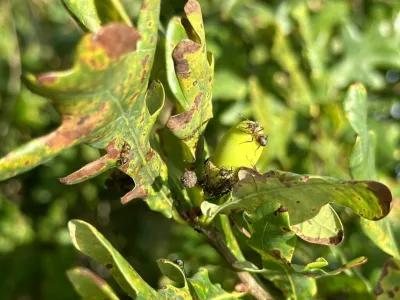
As climate change threatens Europe’s native forests, foresters have increasingly considered introducing non-native tree species such as the northern red oak (Quercus rubra) as substitutes for native oaks. But a new study from southern Sweden warns that such substitutions may come with hidden costs for biodiversity.
Researchers compared biodiversity linked to two native oak species — sessile oak (Quercus petraea) and pedunculate oak (Quercus robur) — with that of the introduced red oak (Q. rubra). They examined everything from arthropods caught in Malaise traps to vascular plants, leaf herbivory, and insects living inside leaves (leaf miners and gallers).
Key findings
Specialised insects decline: The red oak (Q. rubra) supported significantly fewer endophytic insects (such as leaf miners and gallers) compared to native oaks.
Plant richness varies: Vascular plant diversity was slightly lower around sessile oak and red oak sites compared to pedunculate oak.
No major difference in general biodiversity: For broader measures — including arthropod abundance, biomass, and leaf herbivory — biodiversity did not differ significantly between native and non-native oaks.
What it means
The results suggest that while general forest biodiversity may be more strongly influenced by local environmental conditions than by tree species identity, specialised herbivores remain vulnerable to shifts from native to non-native trees. Introducing Q. rubra could therefore reduce the survival of insects that have co-evolved with Europe’s native oaks over centuries.
Franzén, M.; Hall, M.; Salis, R.; Sunde, J.; van Dijk, L.J.A.; Tack, A. J. M.; Forsman A. (2025). Biodiversity impacts of native versus non‑native oaks. Biol Invasions, 27:194. https://doi.org/10.1007/s10530-025-03649-7